
Quantifying Loudness

How do you quantify how loud a sound is? Sounds like a simple question, but it’s not.

What is loudness?

It’s not hard to measure the physical intensity of a sound, but loudness is the perceived intensity of a sound. It is not a physical phenomena but a psychological phenomena.

Loudness is subjective, but not entirely so. There is general consensus regarding what it means for two sounds to be equally loud, and even for ratios, such as saying when one sound is twice as loud as the other. Loudness is quantifiable, but not easily so.

What does loudness depend on?

Loudness depends on several properties of a sound, such as its frequency, bandwidth, and duration. Loudness must depend on frequency because sounds that are too low or too high have no loudness at all because we simply cannot hear them. But even with the range of audible frequencies, loudness varies quite a bit by pitch. The graph below, via Wikipedia, shows equal loudness contours. The blue lines are from work by Fletcher and Munson in 1937. The red lines are the revised curves per the ISO 226:2003 standard.
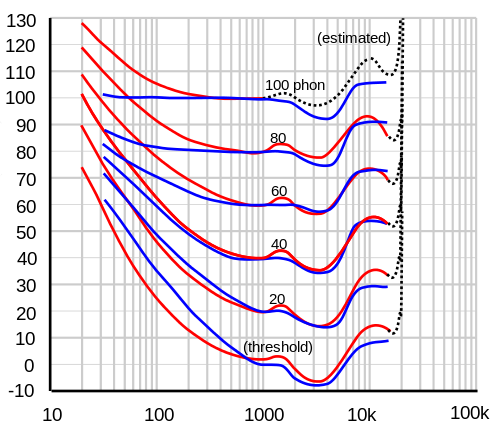
Fletcher-Munson curves

The horizontal axis is frequency in Hz and the vertical axis is sound pressure level in decibels. The contour lines represent combinations of frequency and sound pressure level that are perceived to be equally loud. If a tuba and a flute sound equally loud, the sound pressure level coming from the tuba is much higher.

Notice that the curves are not parallel, They’re much closer together for low frequencies than for midrange frequencies, though they are roughly parallel for high frequencies. This means that if you recorded a piano, for example, playing each of its keys at equal loudness, the pitches wouldn’t sound equally loud unless you played the recording back at its original volume.

Complexities and simplifications

As complicated as this is, it’s still a simplification. It is based on pure tones, simple sine waves. A single musical instrument, much less an orchestra or a jackhammer, are more complicated. Loudness is highly nonlinear, and so you cannot say that the loudness of two sounds is the sum of their individual loudnesses. A-weighting is a relatively simple way to convert sound pressure levels to loudness, but is only accurate for pure tones at fairly low loudness levels.

To simplify thing further, consider a single pure tone, a sine wave at 1 kHz. (This is almost two octaves above middle C. See details here.) Loudness level in phons is defined to match sound pressure level in decibels for a 1 kHz pure tone. So a sound has a loudness level of 40 phons, for example, if it is perceived to be as loud as a pure 1 hKz tone at 40 dB.

At 1 kHz, loudness increases by a factor of 2 for every 10 dB increase in sound pressure level. But because nothing is simple in psychoacoustics, even this is a simplification. It only holds for sounds with loudness level 40 dB or greater. A quiet room is around 40 phons, so the added complications below 40 phons may not be relevant in many applications.

A pure tone at 1 kHz and 20 dB sounds more than four times softer than the same tone at 40 dB. The definition of loudness level in phons still holds below 40 phons. An oboe has a loudness level of 20 phons if it has the same loudness as a sine wave with frequency 1 kHz and sound pressure level 20 dB. But an oboe at 30 phons will sound more than twice as loud as one at 20 phons.

Update: New blog post comparing guitar samples at the same sound pressure level but with differing loudness and sharpness.

Summary

So where are we as far as calculating loudness? We’ve said a lot about what you can’t do, what complications have to be considered. But we’ve concluded this much: for a pure 1 kHz tone, the loudness in phons equals (by definition) the sound pressure level in decibels. And we’ve said how in principle you could define the loudness of other sounds: compare them to a 1 kHz tone that’s just as loud. We haven’t said how to compute this, only how you could determine it empirically.

In future posts I may write about how you do this using the ISO 532B standard or the newer ANSI S3.4-2007 standard.

Related links

Reproducible randomized controlled trials

“Reproducible” and “randomized” don’t seem to go together. If something was unpredictable the first time, shouldn’t it be unpredictable if you start over and run it again? As is often the case, we want incompatible things.

But the combination of reproducible and random can be reconciled. Why would we want a randomized controlled trial (RCT) to be random, and why would we want it to be reproducible?

One of the purposes in randomized experiments is the hope of scattering complicating factors evenly between two groups. For example, one way to test two drugs on a 1000 people would be to gather 1000 people and give the first drug to all the men and the second to all the women. But maybe a person’s sex has something to do with how the drug acts. If we randomize between two groups, it’s likely that about the same number of men and women will be in each group.

The example of sex as a factor is oversimplified because there’s reason to suspect a priori that sex might make a difference in how a drug performs. The bigger problem is that factors we can’t anticipate or control may matter, and we’d like them scattered evenly between the two treatment groups. If we knew what the factors were, we could assure that they’re evenly split between the groups. The hope is that randomization will do that for us with things we’re unaware of. For this purpose we don’t need a process that is “truly random,” whatever that means, but a process that matches our expectations of how randomness should behave. So a pseudorandom number generator (PRNG) is fine. No need, for example, to randomize using some physical source of randomness like radioactive decay.

Another purpose in randomization is for the assignments to be unpredictable. We want a physician, for example, to enroll patients on a clinical trial without knowing what treatment they will receive. Otherwise there could be a bias, presumably unconscious, against assigning patients with poor prognosis if the physicians know the next treatment be the one they hope or believe is better. Note here that the randomization only has to be unpredictable from the perspective of the people participating in and conducting the trial. The assignments could be predictable, in principle, by someone not involved in the study.

And why would you want an randomization assignments to be reproducible? One reason would be to test whether randomization software is working correctly. Another might be to satisfy a regulatory agency or some other oversight group. Still another reason might be to defend your randomization in a lawsuit. A physical random number generator, such as using the time down to the millisecond at which the randomization is conducted would achieve random assignments and unpredictability, but not reproducibility.

Computer algorithms for generating random numbers (technically pseudo-random numbers) can achieve reproducibility, practically random allocation, and unpredictability. The randomization outcomes are predictable, and hence reproducible, to someone with access to the random number generator and its state, but unpredictable in practice to those involved in the trial. The internal state of the random number generator has to be saved between assignments and passed back into the randomization software each time.

Random number generators such as the Mersenne Twister have good statistical properties, but they also carry a large amount of state. The random number generator described here [link died] has very small state, 64 bits, and so storing and returning the state is simple. If you needed to generate a trillion random samples, Mersenne Twister would be preferable, but since RCTs usually have less than a trillion subjects, the RNG in the article is perfectly fine. I have run the Die Harder random number generator quality tests on this generator and it performs quite well.

Need help with randomized trials? Let’s talk.

Timidity about approximating

“Nature does not consist entirely, or even largely, of problems designed by a Grand Examiner to come out neatly in finite terms, and whatever subject we tackle the first need is to overcome timidity about approximating.”

H. and B. S. Jeffreys, Methods of Mathematical Physics, 2nd ed., Cambridge University Press, 1950, p. 8.

Related post: Just an approximation

How did our ancestors sleep?

Electric lighting has changed the way we sleep, encouraging us to lose sleep by staying awake much longer after dark than we otherwise would.

Or maybe not. A new study of three contemporary hunter-gatherer tribes found that they stay awake long after dark and sleep an average of 6.5 hours a night. They also don’t nap much [1]. This suggests the way we sleep may not be that different from our ancient forebears.

Historian A. Roger Ekirch suggested that before electric lighting it was common to sleep in two four-hour segments with an hour or so of wakefulness in between. His theory was based primarily on medieval English texts that refer to “first sleep” and “second sleep” and has other literary support as well. A small study found that subjects settled into the sleep pattern Ekirch predicted when they were in a dark room for 14 hours each night for a month. But the hunter-gatherers don’t sleep this way.

Maybe latitude is an important factor. The hunter-gatherers mentioned above live between 2 and 20 degrees south of the equator whereas England is 52 degrees north of the equator. Maybe two-phase sleep was more common at high latitudes with long winter nights. Of course there are many differences between modern/ancient [2] hunter-gatherers and medieval Western Europeans besides latitude.

Two studies have found two patterns of how people sleep without electric lights. Maybe electric lights don’t have as much impact on how people sleep as other factors.

Related post: Paleolithic nonsense

* * *

[1] The study participants were given something like a Fitbit to wear. The article said that naps less than 15 minutes would be below the resolution of the monitors, so we don’t know how often the participants took cat naps. We only know that they rarely took longer naps.

[2] There is an implicit assumption that the contemporary hunter-gatherers live and, in particular, sleep like their ancient ancestors. This seems reasonable, though we can’t be certain. There is also the bigger assumption that the tribesmen represent not only their ancestors but all paleolithic humans. Maybe they do, and we don’t have much else to go on, but we don’t know. I suspect there was more diversity in the paleolithic era than we assume.

Basic equations of beam deflection

In the preface to his book Strength of Materials, J. P. Den Hartog says

After the alphabet and the tables of multiplication, nothing has proved quite so useful in my professional life as these six little expressions.

The six expressions he refers to are nicknamed the vergeet-me-nietjes in Dutch, which translates to forget-me-nots in English. They are also known as Dr. Myosotis’s equations because myosotis is the genus for forget-me-nots. The equations give the angular and linear deflections of a cantilever beam.

Imagine a beam anchored at one end and free on the other, subject to one of the kinds of load: a bending moment M at the opposite end, a point force P at the opposite end, or a force w distributed over the length of the beam. The equations below give the rotation (angular deflection) and displacement (linear deflection) of the free end of the beam.

Rotation Displacement
Bending moment  ML/EI  ML2/2EI
Point load  PL2/2EI  PL3/3EI
Distributed load  wL3/6EI  wL4/8EI

Here E is the modulus of elasticity, L is the length of the beam, and I is the area moment of inertia.

The name we give to bright ideas

From The Book of Strange New Things:

… I said that if science could come up with something like the Jump it could surely solve a problem like that. Severin seized hold of that word, “science.” Science, he said, is not some mysterious larger-than-life force, it’s just the name we give to bright ideas that individual guys have when they’re lying in bed at night, and that if the fuel thing bothered me so much, there was nothing stopping me from having a bright idea to solve it …

Subway map of the solar system

This is a thumbnail version of a large, high-resolution image by Ulysse Carion. Thanks to Aleksey Shipilëv (@shipilev) for pointing it out.

It’s hard to see in the thumbnail, but the map gives the change in velocity needed at each branch point. You can find the full 2239 x 2725 pixel image here or click on the thumbnail above.

New development in cancer research scandal

My interest in the Anil Potti scandal started when my former colleagues could not reproduce the analysis in one of Potti’s papers. (Actually, they did reproduce the analysis, at great effort, in the sense of forensically determining the erroneous steps that were carried out.) Two years ago, the story was on 60 Minutes. The straw that broke the camel’s back was not bad science but résumé padding.

It looks like the story is a matter of fraud rather than sloppiness. This is unfortunate because sloppiness is much more pervasive than fraud, and this could have made a great case study of bad analysis. However, one could look at it as a case study in how good analysis (by the folks at MD Anderson) can uncover fraud.

Now there’s a new development in the Potti saga. The latest issue of The Cancer Letter contains letters by whistle-blower Bradford Perez who warned officials at Duke about problems with Potti’s research.